SMM11 on the 1st of November, the new national standard of rebar was formally implemented. In the new standard, the inspection regulations of metallographic structure, macroscopic metallography, cross-section Vickers hardness, onlooker organization and inspection methods have been added to the new standard, and the circulation of water-piercing steel bars in the market is prohibited, so as to standardize the standardization of rebar products. In order to meet the requirements of the new national standard, it is necessary to add enough alloy elements to meet the requirements. At present, the industry mainly chooses to add silicon manganese, vanadium and niobium.
The actual amount of silicon and manganese in the new screw thread stimulation alloy has soared by 80%.
After the water penetration process is banned, the amount of manganese in steel bars has increased significantly. According to Shenwan Hongyuan research data, the national silicon and manganese production in the third quarter was 2.28 million, an increase of 24.63 percent over the second quarter of the previous month, of which the monthly output in September reached the highest level since 2015. This is mainly due to the increase in capacity utilization in Inner Mongolia, Ningxia, Guangxi, Guizhou and Chongqing. At the same time, after June this year, the total output of crude steel downstream of silicon and manganese was high, driving demand for silicon and manganese, coupled with the support of manganese ore costs, silicon and manganese prices ushered in a wave of rise under both supply and demand.
Guangxi Silicon Manganese 6517 (acceptance) Price:
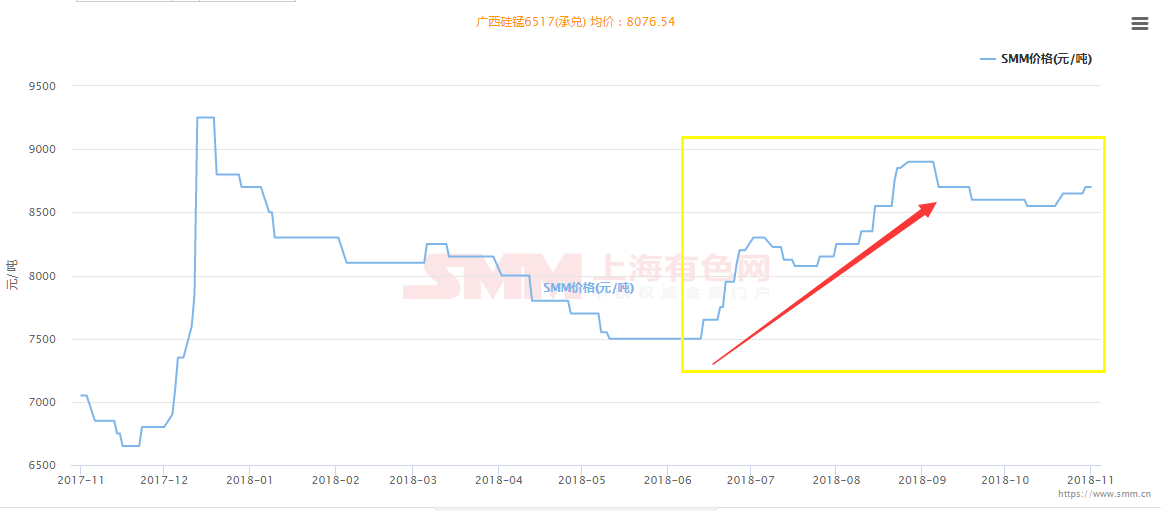
Due to the abolition of the mandatory production limit in the fourth quarter of this year, the differentiation plan has been formulated by various localities. The production limit ratio of Handan and Tangshan to the iron and steel industry is lower than the same period last year, and the production limit plan of Fen-Wei plain is also lower than expected. On the other hand, high profits stimulate the improvement of capacity utilization in unrestricted production areas, coupled with the increase in the use of scrap steel throughout the country, resulting in a decline in the iron-steel ratio, resulting in an increase in domestic iron and steel production. According to the calculation of Shen WanHongyuan research, after considering the production restriction in Beijing-Tianjin-Hebei area and Fen-Wei plain, the daily average crude steel output in 2018-2019 heating season increased by 5% compared with the same period last year. Under good demand, silicon, iron, silicon and manganese prices are expected to remain supportive in the fourth quarter.
SMM believes that as the new standard for rebar comes into effect, there will be considerable new demand for silicon and manganese, which will be more than 40, 000 tons a month. The new production capacity of silicon and manganese in the second half of the year is relatively dense, but after taking into account the delay of the project period, commissioning, and other factors, the actual production output is often on the small side. In the second half of the year to the end of the year, the new monthly output is up to 40,000 tons. In fact, it will be lower, so at least there will not be a situation of serious surplus caused by intensive production, and it is expected that the supply and demand pattern of silicon and manganese industry will remain in a tight balance pattern in the second half of the year.
Vanadium alloy shortage is difficult to find the price under the tuyere doubled between the fingers
Since June this year, vanadium prices have soared to 90,000 miles, doubling all the way. With the complete landing of the November rebar label, the vanadium price is still in the middle of the rising channel. According to the statistics of CITIC Construction Investment Securities, before that, the annual output of rebar in China was about 220 million tons, of which about 60 million tons had been added vanadium, even if it was assumed that 20 million tons of exported rebar steel did not need to add vanadium. There are still about 140 million tons of vanadium to be added, and from the point of view of safety and market recognition, the vast majority of steel mills think that the addition of vanadium is the best choice from the point of view of production process, which directly leads to the fact that vanadium is difficult to obtain at present.
Vanadium prices rose sharply in the third quarter of 2018 (in yuan / ton)
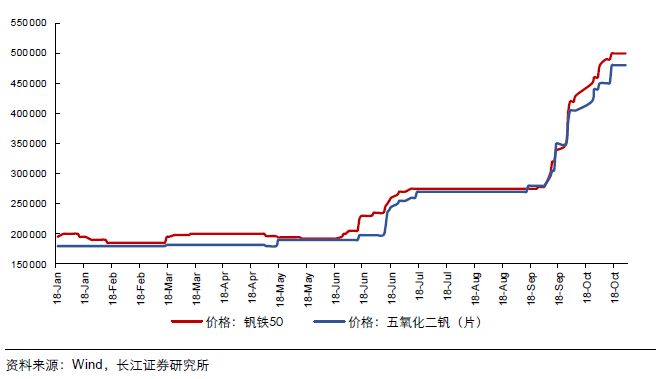
Corresponding to the exuberant demand is the persistently low vanadium inventory. According to the study of Changjiang Securities, under the environmental protection and high pressure, the supply elasticity of small vanadium producers such as vanadium extraction from stone coal is relatively insufficient, and the supply rigidity further pushes up the vanadium price elastic space. Under the mismatch between supply and demand, vanadium stocks continue to fall to historic lows.
At the same time, the vanadium slag, the main raw material of vanadium, comes from the steel slag in the converter steelmaking of vanadium titanium magnetite, and there is a situation of "fixing slag with steel". Because there is no increase in the steel output of the steel mill with vanadium titanomagnetite as the raw material, the vanadium slag has no increment, which makes it difficult to increase the production of vanadium pentoxide in a short period of time. Citic Construction Investment Securities believes that at the same time, even if the current vanadium price has risen more than 10 times from the bottom, because vanadium is a small metal, the market size is limited, and the depth of the market is clear by 2015. Globally, there will be little new capacity in the next 1 or 2 years, and there is a good chance that vanadium will still be in short supply in 2019.
The supply of ferroniobium, a substitute for manganese and vanadium, exceeds the demand, and the price rises into a new tuyere.
As a substitute for ferroniobium, iron niobium began to rise as a substitute for vanadium, which continued to rise. At present, the supply of niobium iron in the market has exceeded the demand, and the price of niobium iron is gradually rising. Although the supply of niobium substitutes is not abundant, but the supply and demand of niobium is not reflected in the price of niobium, Citic Construction Investment Securities believes that it is mainly due to the high concentration of supply in the global niobium market. (CBMM), a Brazilian mining company, supplies about 80 per cent of the world's niobium, and its pricing strategy has long been to stabilize prices and give steel mills stable expectations to promote niobium applications, resulting in a lack of volatility in niobium prices.